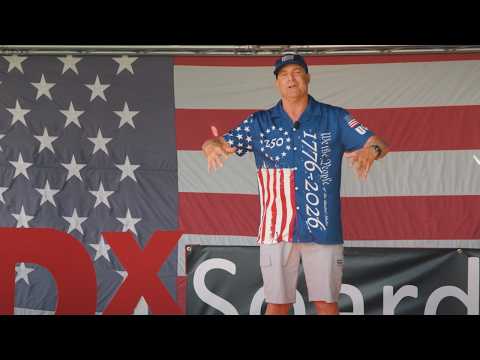
July 4, 2026 Stage • Severe Trauma & ResilienceSession 1: The Anatomy of Resilience: Severe Trauma & Somatic Recovery

Carl Cleavenger: “The Bell Hasn't Rung”

Surviving the Mojave Desert Fire, 7 Surgeries at Grossman, and the 3 Cognitive Anchors of Defiance

The Bell Hasn't Rung
Official 4K Stage Recording • Click to Play

The Bell Hasn't Rung

Presented by Carl Cleavenger

Recorded at Queenslake Horse Farm • July 4, 2026

About Carl Cleavenger

Trauma Survivor, Keynote Speaker & Entrepreneur

Carl Cleavenger is a severe trauma survivor, entrepreneur, and keynote speaker who survived a catastrophic vehicle fire in the Mojave Desert that claimed the life of his special-needs son, James, and left Carl with third-degree burns across more than half his body. Surviving seven major surgeries and six weeks in a medically induced coma at the Grossman Burn Center, Carl rebuilt his physical and psychological capacity through three explicit cognitive anchors: Desire, Movement, and Meaning.

“A prizefighter doesn't lose when he touches the canvas. He loses only when he decides to stay down. The bell hasn't rung in your life.”
Speaker Stage Mini-Gallery

Carl Cleavenger on the Red Circle Carpet

Aggregated directly from the main TEDxSoardsRoad stage gallery (4 photos). Click any photo to enlarge.

Red Circle Stage • Photo 1 of 4

Carl Cleavenger

Carl Cleavenger delivering "The Bell Hasn't Rung" on the TEDxSoardsRoad stage

Carl Cleavenger — "The Bell Hasn't Rung" (Main Stage Portrait)

Deep Dive: Speech Summary & Key Takeaways

9 min read
Core Ideas from This Talk

In this unforgettable keynote, Carl Cleavenger recounts the catastrophic desert buggy fire that claimed the life of his special-needs son James and burned over 50% of Carl's body. Surviving six weeks in a coma and seven skin debridement surgeries at the Grossman Burn Center, Carl deconstructs the three-phase cognitive recovery framework—Desire, Movement, and Meaning—that brought him back to life.

  • 1Physical and emotional recovery requires concrete cognitive anchors, not abstract positive thinking.
  • 2Pain can be systematically channeled through rhythmic stimuli to overcome somatic resistance.
  • 3Accepting vulnerability and the inherent price of love is essential to transforming existential loss into forward movement.
  • 4Defeat is never codified until an individual accepts the final round has concluded.
Drill Down Further
Read Full Chapter-by-Chapter Talk Analysis (4 Chapters)
Analytical Framework

The 3-Phase Kinetic Recovery Architecture

An operational protocol engineered in the burn ICU to sequence cognitive defiance, physical rehabilitation, and philosophical acceptance.

1Phase 1: Desire
Anchor Track: Ozzy Osbourne — 'Desire'
Psychological Defiance & Pain Threshold Overdrive

Utilizing intense rhythmic music (anchored to Ozzy Osbourne's 'Desire') to override excruciating dressing changes and surgical debridement. Desire is the raw, stubborn refusal to let trauma dictate the end of your story.

2Phase 2: Movement
Anchor Track: Saint Motel — 'Move'
Overcoming Contractures via Kinetic Forcing

Direct somatic action to defeat severe scar tissue contractures. Anchored to Saint Motel's 'Move', progressing relentlessly from basic finger articulation to walking, road cycling, and open-water swimming.

3Phase 3: Meaning
Anchor Track: Ratt — 'Nobody Rides for Free'
Radical Acceptance & Purpose Transmutation

Catalyzed by Ratt's 'Nobody Rides for Free', accepting that loving deeply and raising a special-needs child carried inherent risk, and transmuting grief into an unbreakable message of hope for others.

Chapter 1: The Mojave Catastrophe

Over fifteen years, Carl Cleavenger forged an extraordinary bond with his special-needs son, James, who was born with an ischemic cerebellar stroke that severely impaired fine motor control. Father and son turned physical challenge into adventure, embracing swimming, ocean jet skiing, and off-road driving in the Mojave Desert. On an ordinary afternoon, a catastrophic fuel line rupture engulfed their off-road vehicle in an instantaneous fireball. Carl was extracted with third-degree burns covering more than 50% of his body. Despite desperate attempts, James perished inside the vehicle.

Chapter 2: The Grossman Burn Center & The Six-Week Coma

Airlifted to the world-renowned Grossman Burn Center in West Hills, California, Carl was placed into a medically induced coma spanning six weeks. He underwent seven major surgical procedures involving extensive skin debridement, allograft placement, and autograft harvesting. Awakening to the dual reality of catastrophic physical devastation and the loss of his son, Carl realized that survival required more than medical intervention—it demanded a systematic reprogramming of his cognitive state.

Chapter 3: The Tri-Partite Recovery Framework

Carl structured his rehabilitation through three distinct musical and psychological anchors. First came Desire—channeling Ozzy Osbourne to generate raw adrenaline during dressing changes where nerve endings fired uncontrollably. Next was Movement—using Saint Motel's driving rhythms to force contracted scar tissue past excruciating flexion limits. Finally came Meaning—embracing the hard truth that raising James was worth every ounce of suffering, and that his life must honor James's memory.

Chapter 4: The Prizefighter's Final Bell

Carl concludes with a lesson from a retired heavyweight contender: 'You get knocked down four times, five times, six times. The crowd gasps. The ref starts counting. But you are never defeated while the count is underway. You are only defeated if you choose to listen to the whisper that says stay down. Stand up. The bell hasn't rung.'